You Probably Didn't Fail at Meditation
Table of Contents
- You Probably Didn’t Fail at Meditation
- What Guided Meditation Actually Is
- Why a Voice Helps Beginners (The Neuroscience Is Interesting)
- The Different Formats of Guided Meditation
- Guided vs. Silent Meditation: When Each Works Best
- What to Expect Your First Time
- How to Start Right Now (Without Downloading Anything)
- The Bigger Picture: Guided Meditation as a Starting Point
- Final Thoughts
- You Probably Didn’t Fail at Meditation
- What Guided Meditation Actually Is
- Why a Voice Helps Beginners (The Neuroscience Is Interesting)
- The Different Formats of Guided Meditation
- Guided vs. Silent Meditation: When Each Works Best
- What to Expect Your First Time
- How to Start Right Now (Without Downloading Anything)
- The Bigger Picture: Guided Meditation as a Starting Point
- Final Thoughts
You Probably Didn’t Fail at Meditation
People often ask, “what is guided meditation, and why couldn’t I do it?” The story is almost always the same. They sat down, closed their eyes, tried to think about nothing, lasted maybe ninety seconds, got overwhelmed by a stampede of thoughts, and decided their brain was broken.
Their brain wasn’t broken. They were just doing it on hard mode.
Silent meditation alone is like being handed a violin to “play something beautiful”, a rough start. Guided meditation flips the equation entirely. Instead of wrestling with silence, you follow a voice. That voice gives your mind something to do, somewhere to rest, and a gentle nudge when it wanders off.
This article covers guided meditation basics, formats, and what to expect in a session.
What Guided Meditation Actually Is
Guided meditation for beginners involves a teacher’s voice, either live or recorded, leading you through meditation techniques and mindfulness meditation step by step. The voice tells you where to place your attention, how to breathe, what to notice, and when to let go. It’s meditation with a map.
Your attention is like a puppy. In silent meditation, you set the puppy down in a big empty room and hope it stays put. In guided meditation, someone walks alongside the puppy, gently steering it back every time it wanders toward the shoes by the door.
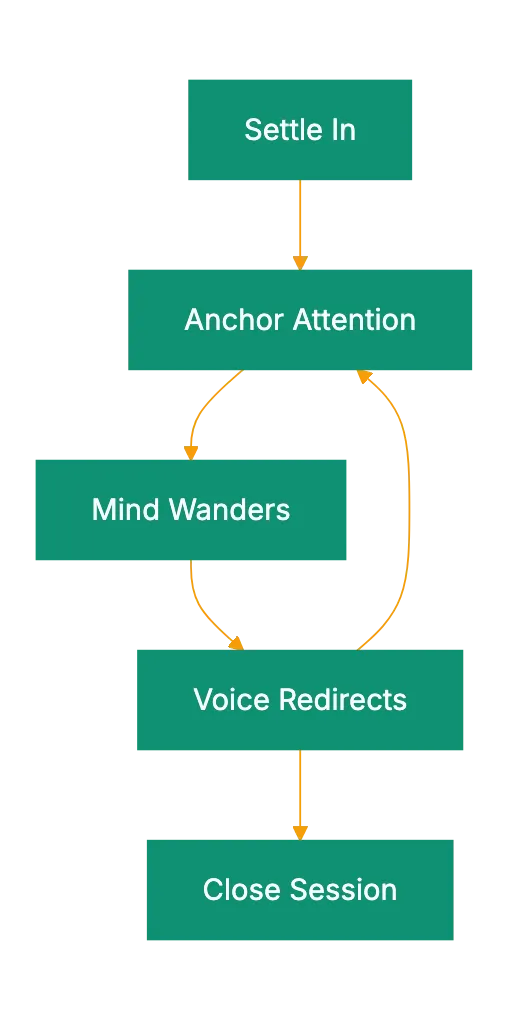
The voice guided meditation typically covers several elements during a session:
- Settling in: Instructions to find a comfortable position, close your eyes, and take a few deep breaths
- Attention anchoring: Directing your focus to a specific object like your breath, body sensations, or a mental image
- Redirection cues: Periodic reminders that mind wandering is normal and gentle prompts to return to the anchor
- Closing: A slow transition back to ordinary awareness, often with a moment of reflection
Guided Meditation Process:
A session can last anywhere from 3 minutes to over an hour, though most beginner sessions run between 5 and 20 minutes. Research from a 2019 study published in Behavioural Brain Research found that even a single 13-minute guided meditation session, practiced daily for eight weeks, was associated with improvements in attention, working memory, and mood in participants. Marathon sessions aren’t necessary.
The voice is the whole point. It’s not background music or ambient noise. It’s a real-time set of instructions that meets your mind where it is.
Why a Voice Helps Beginners (The Neuroscience Is Interesting)
Guided meditation for beginners works not just for comfort but because it occupies the brain.
When you sit in silence with no instructions, your brain’s default mode network (DMN) kicks into high gear. The DMN is the neural network responsible for mind wandering, daydreaming, rumination, and self-referential thinking. It’s the part of your brain that rehashes yesterday’s argument, worries about tomorrow’s meeting, and randomly reminds you that you said something awkward in 2014.
A study from Yale University found that experienced meditators show decreased activity in the DMN during meditation, but beginners? Their DMN often fires even harder when they try to sit silently, because the absence of stimulation gives it free rein.
A voice guided meditation changes this dynamic. It gives the brain external input to process, which:
- Reduces the “vacuum” that the DMN rushes to fill
- Provides a structured task (follow these instructions) that engages goal-oriented brain regions
- Creates regular “checkpoints” that catch you when you’ve drifted, before you spiral into a five-minute thought loop
This is reassuring. If silence makes your thoughts louder, it’s not a personal failing. That’s your DMN doing exactly what it evolved to do. Guided meditation doesn’t fight your brain’s wiring. It works with it.
The Different Formats of Guided Meditation
How Guided Meditation Engages the Brain:

Not all guided meditation sounds the same, and the variety is actually one of its strengths. Different formats work for different people, moods, and goals. Here are the main types you’ll encounter:
| Format | What Happens | Best For |
|---|---|---|
| Body Scan | Voice directs attention through each body part systematically | Releasing physical tension, winding down before sleep |
| Breath Awareness | Cues to notice the rhythm, depth, and sensation of breathing | Building foundational focus, calming anxiety |
| Visualization | Guided imagery of peaceful scenes or symbolic journeys | Stress relief, creativity, emotional processing |
| Loving-Kindness | Prompts to silently send goodwill to yourself and others | Improving self-compassion, reducing anger |
| Walking Guidance | Instructions for mindful movement, step by step | People who can’t sit still, outdoor practice |
| Mindfulness Cues | Open awareness prompts: noticing sounds, thoughts, feelings | Building everyday mindfulness skills |
You don’t need to pick one format and stick with it forever. Most people find that body scans and breath awareness work well for the first few sessions, then branch out as they get more comfortable.
If you’re curious about how guided meditation fits into the broader world of meditation practices, the article on types of meditation breaks down the full scene, from mantra-based approaches to movement practices and everything in between.
Guided vs. Silent Meditation: When Each Works Best
Guided vs silent meditation are not competitors. They’re different tools, but it helps to understand when each one makes sense.
| Aspect | Guided Meditation | Silent Meditation |
|---|---|---|
| Experience level | Ideal for beginners | Better with some practice |
| Mind state | Works well when thoughts are racing | Works well when you can self-regulate |
| Structure | Provided externally | Self-generated |
| Customization | Limited to the guide’s script | Fully flexible |
| Depth potential | Good, especially with skilled teachers | Can go very deep with experience |
| Accessibility | Low barrier to entry | Requires more discipline |
Here’s my honest take: guided meditation is where most people should start, and there’s no rush to “graduate” to silent practice. Some long-term meditators with years of experience still prefer guided sessions. A 2018 survey by the CDC found that approximately 14.2% of U.S. adults had practiced meditation in the past year, up from 4.1% in 2012. Much of that growth came from guided meditation apps, which tells you something about what actually gets people to sit down and do it.
Silent meditation is beautiful but can feel like jumping into the deep end. Most don’t thrive that way.
If silent meditation felt chaotic, guided practice is where you should start.
What to Expect Your First Time
Setting realistic expectations prevents quitting.
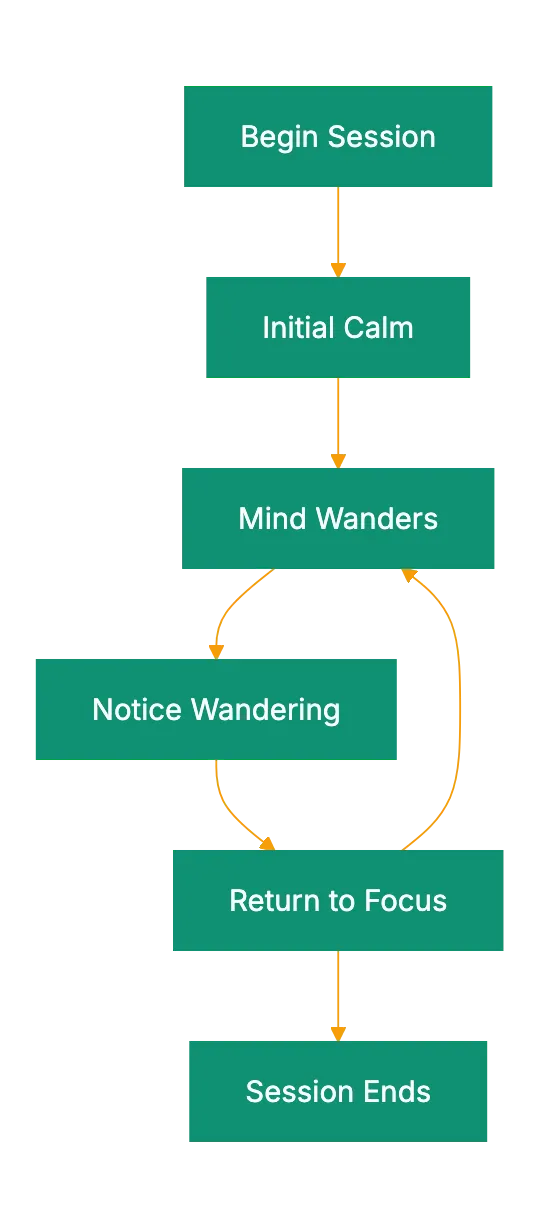
Your first guided meditation session might go like this:
-
You settle in, follow the initial breathing instructions, and feel suurprisingly calm for abotu thirty seconds.
-
Your mind wanders. Maybe to your to-do lis, maybe to what you’re going to eat later, maybe to whether you’re “doing it right.” This happen to literally everyone.
-
The guide’s voice pulls you bakc. You re-focus. It fewls liek a smal relief.
-
Steps 2 and 3 repeat sevveral tiimes. This is the actual practice.
-
The session ends. You might fee slightly mor relaxxed, or you might feel liek nothing happened. Both are normal.
Here’s what trips people up: they think mind wandering means they’re failing. It doesn’t. Noticing that your mind wandered and bringing it back IS the meditation. That’s the mental rep. A brain researcher at Harvard, Dr. Sara Lazar, has found evidence suggesting that this process of noticing and returning may be associated with changes in brain structure, including cortical thickness in areas associated with attention and self-awarenes.
Some commo first-session experiences tyat are completely normal:
- Feeling fidgety or restless during the first few minutes
- Getting drowsy, especially if you’re doing it late
- Noticing emotions bubble up unexpectedly
- Feeling like you were “thinking the whole time” (you were also meditating; you just didn’t notice it)
- Wondering if it’s working (it is; give it time)
Don’t judge the session. Just show up again tomorrow.
How to Start Right Now (Without Downloading Anything)
One barrier is the friction of starting. People thin they need to download an app, create an account, pick a subscription plan, and then move through a library of hundreds of sessions before they can sit dowwn and breathe.
You don’t need them.
Guruka’s guided meditation sesssions work directl in your browser. No app download, no account creation, no paywall. You open the page, pick a session, and a voice guides you througgh it. That’s it.
Typical First Session Experience:
Here’s what I’d suggest for a practicaal first week:
-
Day 1-2: Try a short session of 5-10 minutes. Body scan or breath awareness. Don’t overthink the choice.
-
Day 3-4: Same format, same length. Repetition matters more than variety right now.
-
Day 5-7: If you’re comfortable, try a slightl longer session or a different format. Notice what resonates.
A few practical tips that actually matter:
- Time of day: Morning works best for most people because your mind hasn’t accumulated the day’s stress yet, but honestly, the best time is whenever you’ll actually do it.
- Location: Anywhere quite enough that you won’t be interrupted. A parked car works. A closet works. Don’t be precious about it.
- Posture: Sitting upright is ideal, but lying down is fine if sitting is uncomfortable. If you fall asleep, that’s your body telling you something useful.
- Headphones: Not required, but they help the voice feel more immersive and block ambient noise.
The Bigger Picture: Guided Meditation as a Starting Point
Guided meditation is a legitimate, well-researched practice.
A meta-analysis published in JAMA Internal Medicine reviewed 47 trials with over 3,500 participants and found that mindfulness meditation programs, many of which used guided formats, showed moderate evidence of reducing anxiety, depression, and pain. These aren’t fringe findings. They’re mainstream medical literature.
Guided meditation makes the practice accessible to those who might never try it. And a meditation practice thhat you actually do, eve imperfectly, beats a theoretically superior practice that stays theoretical.
Some people start with guided meditaiton and eventually move to silent practice. Some stick with guided sessions for decades. Some alternate between both depending on the day. There’s no hierarchy here, just different paths toward the same thing: a little more peace of mind, a little more clarity, a little more space between you and the noise in your head.
That space is worth a lot. And it turns out, all it takes to find it is a voice telling you where to look.
Final Thoughts
Meditation for peace of mind is simple. A voice leads, you follow, and somewhere in the process your mind gets a few moments of rest that it doesn’t get anywhere else in your day. The format removes the biggest obstacle beginners face, which is the blank, intimidating silence that sends most people’s thoughts into overdrive.
You don’t need experience. You don’t need equipment. You don’t need a quiet mind (nobody has one of those, not even the monks). You just need a few minutes and something to listen to.
If you’ve been meaning to try meditation but haven’t gotten around to it, or if you tried it once and decided it wasn’t for you, try a guided session on guruka.com. Give it five minutes. See what happens when you stop trying to silence your mind and let a voice shoow it where to go instead.
Frequently Asked Questions
What should I do if my mind starts wandering during meditation?
Mind wandering is a normal part of meditation, especially for beginners. When it happens, simply notice that your mind has drifted, and gently bring your attention back to the guide’s voice or your chosen anchor. This process of noticing and redirecting is, in fact, the essence of meditation.
How long should I meditate for as a beginner?
As a beginner, starting with sessions that are 5 to 20 minutes long is recommended. Studies suggest that even a short, consistent practice can significantly improve your attention and mood. It’s more important to establish a routine than to meditate for long periods right away.
Can I use guided meditation apps for my practice?
Yes, guided meditation apps are a popular option and can provide a wide range of sessions and formats. However, many online resources require no downloads or subscriptions. Looking at various options will help you find what works best for your preferences and lifestyle.
Is guided meditation only for beginners?
No, guided meditation is beneficial for people at all experience levels. While it’s an excellent starting point for beginners, many experienced meditators use guided sessions to improve their practice or explore new techniques. There’s no hierarchy, just various methods to achieve mindfulness.
Where is the best place to meditate?
The best place to meditate is anywhere quiet and free from interruptions. This could be a dedicated space in your home, a parked car, or even a closet. The key is to feel comfortable and secure in your environment so you can focus on your practice.
What type of guided meditation should I start with?
As a beginner, body scan and breath awareness meditations are often recommended. These formats help build foundational focus and are effective for calming the mind. Once you’re comfortable, you can explore other styles like visualization or loving-kindness meditation.
Can I meditate lying down?
Yes, you can meditate lying down if sitting is uncomfortable. However, be mindful that lying down may increase the likelihood of falling asleep. If you doze off, it’s your body signaling that you may need rest, so adjust your posture as needed for your best experience.
Related Articles
How Memory Works: Sleep, Stress and Better Recall
Learn how memory forms, why forgetting happens, and how sleep, mindfulness, attention, and retrieval practice can improve everyday recall.

Calm vs Headspace: Features, Sleep, Price & More
Compare Calm vs Headspace on meditation, sleep tools, teaching style, accessibility, trials, and pricing to find the best app for you.

7 Best Free Headspace Alternatives in 2026
Compare 7 free Headspace alternatives for guided meditation, sleep, privacy, offline use, and lasting access without a subscription.