Calm vs Headspace: Features, Sleep, Price & More
Table of Contents
- Calm vs Headspace: The Short Answer
- Headspace vs Calm App at a Glance
- Calm vs Headspace: Guided Meditation Teaching Styles
- Guided Meditation Courses and Daily Mindfulness
- Calm vs Headspace for Sleep Meditation
- Mindfulness App Features Beyond Seated Meditation
- Pricing, Trials, and Subscription Traps
- Accessibility, Languages, and Platforms
- Which Headspace vs Calm App Style Fits Your Routine?
- Bottom Line
- Calm vs Headspace: The Short Answer
- Headspace vs Calm App at a Glance
- Calm vs Headspace: Guided Meditation Teaching Styles
- Guided Meditation Courses and Daily Mindfulness
- Calm vs Headspace for Sleep Meditation
- Mindfulness App Features Beyond Seated Meditation
- Pricing, Trials, and Subscription Traps
- Accessibility, Languages, and Platforms
- Which Headspace vs Calm App Style Fits Your Routine?
- Bottom Line
Calm vs Headspace: The Short Answer
TL;DR: The Calm vs Headspace choice seems simple until you open both apps. Both offer guided meditation, sleep content, breathing exercises, and everyday stress programs, but feel remarkably different. Calm resembles a quiet media library: choose a soothing voice, story, soundscape, or meditation and settle in. Headspace feels more like a friendly course: learn a technique, practice it, and build on it tomorrow.
That difference matters when fitting mindfulness around work, family, sleep changes, and phone notifications. This comparison examines teaching style, meditation courses, sleep tools, accessibility, platforms, trials, and verified U.S. pricing. Practical examples can help you decide. Neither app is medical treatment, but both can structure mindfulness practice and bring more peace to an ordinary day.
Source page reviewed in Chrome during article research. Follow the image link for the current page.
Headspace vs Calm App at a Glance
This table captures the practical differences. Features and prices were checked on July 19, 2026; taxes, promotions, currencies, and app-store billing can change what you see.
| Feature | Calm | Headspace |
|---|---|---|
| Overall style | Atmospheric, spacious, content-led | Structured, instructional, course-led |
| Best-known sleep format | Celebrity-narrated Sleep Stories | Immersive sleepcasts with changing details |
| Meditation approach | Stand-alone sessions plus multi-day programs | Progressive courses and clearly taught techniques |
| Daily practice | Daily Calm, typically 10 minutes | A daily meditation and recommended practice |
| Other content | Music, soundscapes, mindful movement, masterclasses | Focus music, movement, Wake Up videos, breathing exercises |
| Free access | Limited meditations, breathing, scenes, and selected sleep content | Limited rotating or sample content; availability may vary |
| Main platforms | iOS, Android, and web | iOS, Android, and web |
| U.S. individual annual price | $79.99 per year through the standard web trial offer | $69.99 per year on the U.S. Apple App Store |
| U.S. monthly price | May appear through app stores; check the purchase screen | $12.99 per month on the U.S. Apple App Store |
| Standard trial shown | 14 days on Calm’s U.S. website; mobile offers can differ | 14 days for annual or 7 days for monthly, depending on offer |
Choose Calm if atmosphere and sleep variety keep you returning; choose Headspace for logically ordered instruction.
Calm vs Headspace: Guided Meditation Teaching Styles
A guided meditation app succeeds only if you use it, so personality may matter more than catalog size.
Headspace generally explains what you are doing and why. Its beginner material teaches following the breath, noting thoughts, body scanning, and observing without immediately reacting. The tone is conversational, visual, and reassuring. If you prefer lessons with clear next steps, Headspace makes choosing easier.
Calm also offers beginner instruction, but discovery feels less linear. You might choose a session by duration, teacher, mood, or topic. Its production favors quiet backgrounds, nature imagery, music, and slower pacing. That freedom is pleasant when you know what you want, but otherwise resembles browsing a large streaming service.
Consider two realistic users:
- Daniel, 42, new to meditation: He wants to understand why his attention wanders. Headspace’s Basics sequence gives him a clearer learning path.
- Sofia, 51, returning to practice: She already understands breath awareness and wants different teachers and session lengths. Calm’s library gives her more room to choose.
My rule is blunt: choose Headspace if too many options make you close an app, or Calm if repetition makes you restless.
Guided Meditation Courses and Daily Mindfulness
Both apps cover stress, focus, self-esteem, relationships, grief, and sleep; they differ in organization.
Headspace tends to package meditation as skill development. Courses encourage you to return, with sessions often available in five, 10, or 20 minutes. Calm combines sequential programs with more individual sessions. The Daily Calm adds a new 10-minute practice each day, which suits people who want variety without searching.
A useful headspace vs calm trial should test behavior, not catalog size:
- Choose one recurring moment, such as after coffee or before opening email.
- Practice for 10 minutes on five days during the first week.
- Record only two facts: whether you started and whether the voice suited you.
- During week two, try one course and one stand-alone session.
- Keep the app that required less negotiation with yourself.
Research offers limited encouragement. An eight-week randomized Calm study analyzed 88 stressed university students and reported moderate-to-large effects across measured outcomes, but the participants were mostly young women and the comparison used a wait-list rather than another meditation app. A broader systematic review of Headspace and Calm trials found promising results alongside methodological and conflict-of-interest concerns. The evidence supports caution, not promises.
Calm vs Headspace for Sleep Meditation
The apps differ most on sleep. Calm’s signature Sleep Stories are gentle narratives read by actors, authors, and other recognizable voices. Calm says Premium includes more than 300 stories, alongside sleep music, ambient scenes, and soundscapes. This suits people whose planning quiets with spoken stories.
For sleep meditation, Headspace uses sleepcasts: descriptive journeys through places such as a night market, marina, or slow-moving train. Some details change between plays, discouraging you from memorizing the narrative. It also offers sleep music, wind-down exercises, white noise, and other audio.
| Sleep preference | Better first choice | Reason |
|---|---|---|
| Familiar narrator and a conventional story | Calm | Its Sleep Stories have stronger narrator and narrative variety |
| A low-stakes imaginary trip | Headspace | Sleepcasts are designed around drifting descriptions |
| Nature sounds playing for an extended period | Calm | Soundscapes and background scenes are central to the experience |
| A repeatable wind-down routine | Headspace | Its sleep exercises fit a more guided sequence |
Marta, 58, wakes at 3 a.m. and finds instructions irritating. A familiar Calm story gives her something neutral to follow. James, 36, carries unfinished work into bed; Headspace’s guided wind-down provides a clearer transition.
Neither service can diagnose persistent insomnia. For frequent, severe, or safety-affecting sleep problems, consult a health professional.
Mindfulness App Features Beyond Seated Meditation
Your choice may depend on what you use instead of guided meditation. Both apps extend well beyond timers and guided sessions.
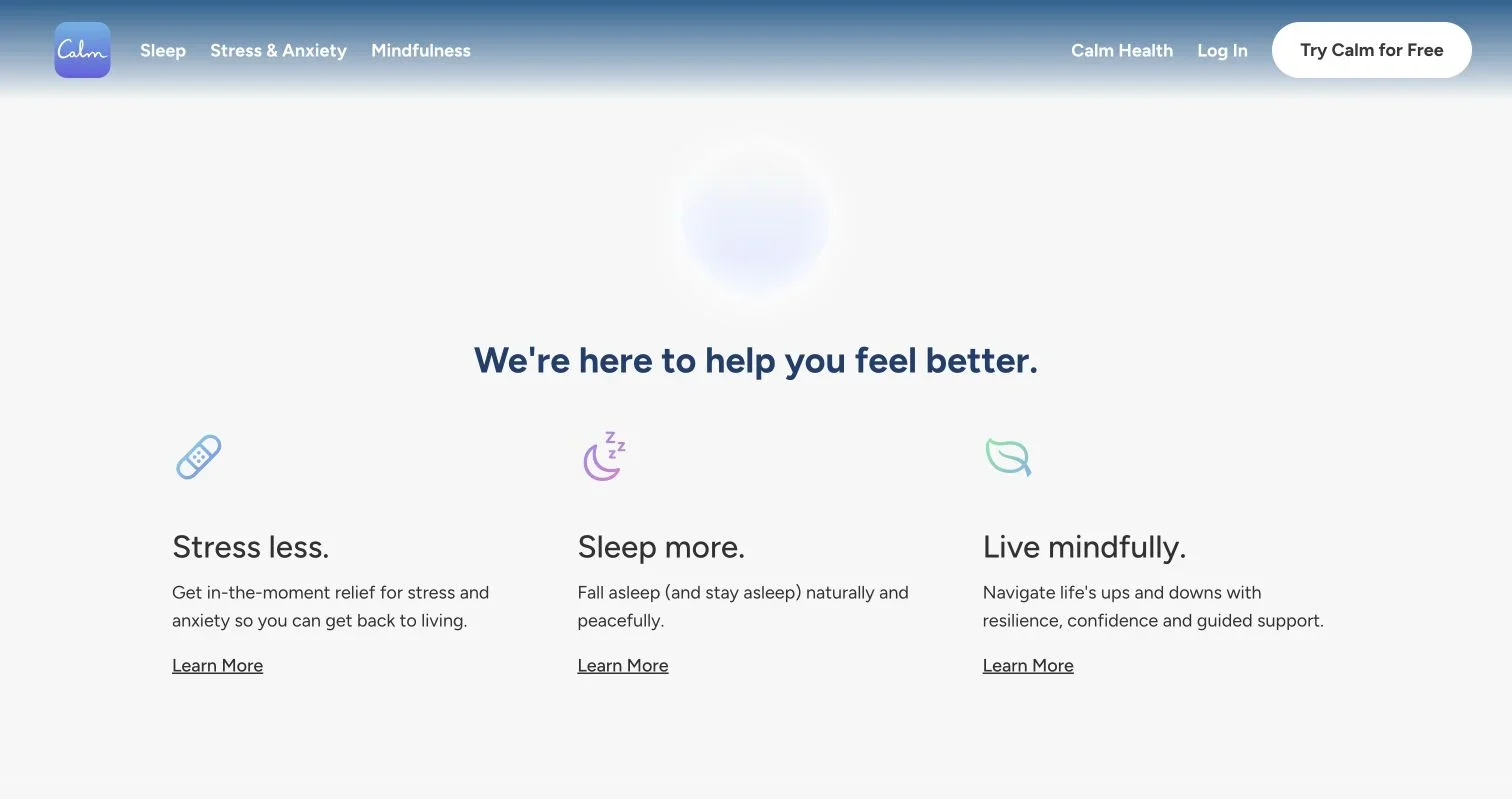
According to the official Calm homepage, its main experience is organized around sleeping more, feeling less stressed, and living mindfully. Premium also includes music, masterclasses, Daily Move sessions, and a large sleep catalog. Headspace’s official subscription page lists meditation, sleep, movement, Wake Up content, and focus audio.

Source screenshot: Calm’s official homepage, checked July 19, 2026.
Consider which extras you will use:
- For concentration: Would you play focus music while writing or doing administrative work?
- For movement: Do short guided stretches feel more approachable than another seated session?
- For mornings: Would a brief daily video help you begin deliberately, or become one more feed to check?
- For evenings: Do stories and soundscapes appeal more than technique-based meditation?
Headspace offers the more consistent learning environment; Calm offers the more convincing relaxation environment. That is the distinction I keep returning to.
Pricing, Trials, and Subscription Traps
Prices may vary across websites, app stores, currencies, taxes, and promotions. Calm’s official U.S. web-trial documentation currently states that its 14-day trial converts to $79.99 per year on day 15. Calm also notes that mobile trials may last seven days and that in-app prices can differ. The official U.S. Apple listing for Headspace shows $12.99 monthly and $69.99 annually; Headspace advertises a 14-day annual trial, while its help center says a seven-day offer converts to monthly billing.
| Cost check | Calm | Headspace |
|---|---|---|
| Annual individual price used for this comparison | $79.99 | $69.99 |
| Approximate annual cost per month | $6.67 | $5.83 |
| Monthly option | Check the store or checkout shown to you | $12.99 |
| Trial-to-paid conversion | Automatic unless canceled | Automatic unless canceled |
| Price caveat | Region, platform, eligibility, and promotions matter | Region, platform, eligibility, and promotions matter |
Headspace costs about $10 less annually, but an unused app saves nothing.
Before starting either trial:
- Screenshot the renewal amount and date.
- Add a calendar reminder at least 48 hours before renewal.
- Confirm where billing is managed: the company website, Apple, or Google Play.
- Check employer, university, insurer, family, and partner benefits before paying.
- Cancel through the same billing channel if the app does not fit.
This prevents confusing a free trial with a free plan.
Accessibility, Languages, and Platforms
Both services work on iOS, Android, and the web, so you can practice without keeping a phone nearby. Calm states that Premium access follows the same account across its supported platforms. Headspace also provides mobile and web access, although particular functions and downloads can differ by device.
Before paying, test the accessibility features that matter to you:
| Item | What to check | Why it matters |
|---|---|---|
| Captions and transcripts | Whether the sessions you want include readable text | Audio-only instruction may exclude some users or situations |
| Screen-reader navigation | Whether buttons, tabs, and player controls have usable labels | A beautiful interface can still be frustrating to move through |
| Text and contrast | Readability at your preferred device settings | Low contrast and small labels add friction |
| Language library | Depth of content, not merely menu translation | English libraries may contain more teachers and programs |
| Offline playback | Which sessions can be downloaded in the mobile app | Useful for travel or unreliable connections |
Calm supports several languages, including English, Spanish, French, and German, but says availability differs by language and region. Headspace likewise operates in multiple languages. Do not assume every English course has a translated equivalent.
Before traveling, download two short practices and one sleep track. This five-minute test reveals more than a feature page.
Which Headspace vs Calm App Style Fits Your Routine?
The fairest verdict depends on when you plan to use the app. Choose for your actual Tuesday, not for the idealized person who meditates at sunrise every day.
Choose Calm first if most of these statements sound familiar:
- You want sleep stories, nature audio, music, and meditation in one place.
- You prefer selecting among teachers and topics.
- A quiet visual design affects whether you can settle.
- You already know basic meditation techniques.
- You expect evening use to outweigh morning lessons.
Choose Headspace first if these fit better:
- You want a beginner curriculum with clear progression.
- You appreciate short explanations and memorable animations.
- You prefer recommendations over browsing.
- You want meditation, focus, movement, and sleep to feel connected.
- You are more likely to maintain a course than sample a large library.
Elena and Robert, both 47, want one household app. Elena uses stories at bedtime; Robert wants a beginner course before work. Each tests the app at the intended time for seven days. If separate profiles and family pricing are available in their region, they compare that cost too. The winner produces more completed sessions, not a longer content list.
Bottom Line
Headspace is stronger for structured learning, especially for beginners who want each session to lead to the next. Calm is more appealing for relaxation, teacher variety, soundscapes, and bedtime listening.
Headspace currently has the lower standard U.S. annual price in this comparison, while Calm offers a limited free tier and an especially deep sleep library. Prices and trials can change by platform and region, so treat the purchase screen as the final authority.
Run a small experiment. Try each app at the same time of day for at least five sessions, noting which voice, structure, and interface creates less resistance. The better app is rarely the one with the most features; it is the one still easy to open after the novelty wears off.
Frequently Asked Questions
Is Calm or Headspace better for beginners?
Headspace is generally the easier starting point because its courses explain meditation techniques in a clear sequence. Calm can also work for beginners, but its larger, less-linear library may require more browsing.
Which app is better for sleep?
Calm is a strong choice if you prefer traditional bedtime stories, familiar narrators, nature sounds, and ambient audio. Headspace may suit you better if you want imaginative sleepcasts or a structured wind-down routine.
How should I compare Calm and Headspace during their free trials?
Use each app at the same time of day for at least five sessions rather than sampling random features. Compare how easily you start, whether the instructor’s voice suits you, and whether you prefer a guided course or stand-alone sessions.
Can I use Calm or Headspace without paying?
Calm provides a limited selection of free meditations, breathing tools, scenes, and sleep content. Headspace may offer samples or rotating free content, but availability can vary, so check the current app or website before subscribing.
How can I avoid an unexpected subscription charge?
Before accepting a trial, record the renewal date, price, and billing provider shown at checkout. Set a reminder at least 48 hours before renewal and cancel through the same website or app store where you subscribed if you decide not to continue.
Can I use the apps while traveling or without an internet connection?
Both services support mobile and web access, but offline playback depends on the device and content type. Download a few meditations and a sleep track before traveling, then confirm they play without a connection.
Can Calm or Headspace replace professional treatment?
No. These apps can support a mindfulness routine and help with everyday relaxation, but they do not diagnose or treat medical or mental health conditions. Seek professional care for persistent, severe, or safety-affecting stress, sleep, or mental health concerns.
Related Articles

Best Balance App Alternatives in 2026
Compare the best Balance app alternatives for meditation, focus, and sleep, including free options, prices, privacy, and features.

Best Insight Timer Alternatives: Free & Paid Apps
Compare the best Insight Timer alternatives for meditation, sleep, privacy, structured courses, personalization, and free access.
7 Best Free Headspace Alternatives in 2026
Compare 7 free Headspace alternatives for guided meditation, sleep, privacy, offline use, and lasting access without a subscription.